
Chemical Analysis
Review the chemical composition, oxide percentages and mineral content of the garnet abrasive.

Supply of red garnet sand and green garnet sand
for a wide range of industrial applications
Professional guidance on garnet type, mesh size, order quantity and packaging
Showing all 2 results
Green garnet sand is a mineral abrasive based on grossular or uvarovite garnet, with green to brown color tones and controlled particle sizing. Available in various mesh sizes, it is suitable for rust removal, paint stripping, metal surface preparation, and selected industrial filtration applications.
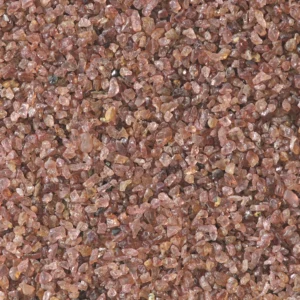
Red garnet sand is a mineral abrasive primarily composed of almandine garnet, characterized by its natural red tone and particles ranging from well-formed crystals to irregular grains. It is available in different mesh sizes, with each grade selected according to particle size and shape for applications such as sandblasting, waterjet cutting and industrial filtration.
The two main products in this category are red garnet sand and green garnet sand. They differ in mineral composition, hardness, density, abrasion resistance, particle breakdown rate, recyclability and initial price.
| Criterion | Red Garnet | Green Garnet |
| Mineral type | Almandine | Grossular or uvarovite |
| Mohs hardness | 7.0 to 7.5 | 6.5 to 7.0 |
| Density | 3.95 to 4.30 g/cm³ | 3.55 to 3.81 g/cm³ |
| Particle breakdown after one blasting cycle* | Approximately 10% to 20% by mass | Approximately 15% to 40% by mass |
| Reusability | 3 to 5 cycles; under controlled conditions, approximately 5 to 10 cycles | 1 to 2 cycles; under controlled conditions, approximately 2 to 3 cycles |
| Initial price | Higher | Lower |
* Particle breakdown depends heavily on factors such as air pressure, impact angle, substrate hardness, particle size distribution, grain shape and the type of abrasive recovery system. The stated values are approximate engineering ranges and should not be considered fixed mineral specifications.
This is a general comparison. Final product selection should be based on technical specifications, batch analysis results, equipment type and the operating conditions of the project.
Review the relevant product page for specifications, analysis reports and supply conditions.
Industrial garnet sand is used as a high-performance garnet abrasive for sandblasting, rust removal, paint stripping, surface preparation, waterjet cutting and selected industrial water filtration applications.
The correct garnet type and particle size must be selected according to the application, equipment specifications, substrate material and required result. Not every grade of garnet sand is suitable for every industrial application.
When selected correctly, garnet abrasive sand can support uniform surface preparation, lower dust generation and reduced residual contamination, as well as higher operational efficiency.
Product quality depends on the raw material and processing stages, including crushing, washing, drying, impurity separation and accurate screening. Characteristics such as moisture, dust content, purity and particle-size consistency should be verified using the sample and analysis report supplied for the relevant product or batch.
The technical specifications of industrial garnet sand vary according to mineral type, mine source, processing method and individual production batch. When selecting a product, parameters such as mesh size, particle-size distribution, hardness, density, moisture, purity and chemical composition should be checked against a valid technical analysis.
| Technical Parameter | Importance in Product Selection |
|---|---|
| Mineral type and composition | Used to evaluate the mineral characteristics and particle durability |
| Mesh size and particle distribution | Ensures compatibility with the nozzle, equipment or filter bed |
| Hardness and density | Used to assess abrasive performance and particle behaviour |
| Moisture and fine particles | Used to evaluate flowability and the risk of particle clumping |
| Purity and chemical composition | Ensures compliance with the technical requirements of the project |
| Packaging and delivered weight | Supports transportation, storage and consumption planning |
The exact values of these parameters must be confirmed using the analysis sheet supplied for the relevant product.
For a more detailed review of each product, you can check its chemical analysis, physical analysis, mesh-size information and particle-size distribution.
Review the chemical composition, oxide percentages and mineral content of the garnet abrasive.
Review hardness, density, moisture, particle shape and other physical properties of the product.
Review the particle-size range and select the appropriate garnet mesh size for your equipment and application.
Selecting the correct type and particle size of industrial garnet sand depends on the application, equipment specifications, substrate material, expected result and technical conditions of the project.
For more accurate product selection, provide our sales team with information about your application, equipment, required mesh size and estimated consumption.
The price of industrial garnet sand is not fixed. It is calculated according to the product type, mesh size, particle-size distribution, processing quality, order quantity, packaging method, loading location and delivery destination.
Depending on the product and order volume, garnet abrasive can be supplied in bags, jumbo bags or bulk shipments. Freight costs are determined according to shipment weight, distance between the loading point and destination, and the selected transportation method.
To receive an accurate garnet sand price, provide the required garnet type, mesh size, order quantity, packaging preference and delivery location.
Garnet sand is a hard and durable mineral abrasive used for sandblasting, surface preparation, rust removal, paint stripping and waterjet cutting. Garnet purity, particle size and grain shape directly affect its performance.
The performance of red garnet and green garnet cannot be determined by colour alone. Specifications such as hardness, purity, resistance to particle breakdown, dust content, particle-size distribution and recyclability must be evaluated. The final selection should be based on the application and technical requirements of the project.
Yes. In some sandblasting operations, garnet abrasive can be collected, separated, cleaned and reused. The number of recycling cycles depends on garnet quality, particle breakdown, blasting pressure, surface contamination and the abrasive recovery method.
Garnet sand for sandblasting is selected for surface cleaning and profile creation. Waterjet garnet requires a more accurate particle-size distribution, better flowability and lower impurity levels to reduce the risk of feed-system blockage and maintain cutting quality.
Mesh size, particle-size distribution, hardness, specific gravity, purity, moisture content, dust content, particle shape and resistance to breakdown are among the most important specifications of industrial garnet sand. These characteristics should be evaluated according to the intended application.
The amount of free silica depends on the quality and processing of the garnet product. A technical analysis or product data sheet should be checked for accurate information. Using garnet abrasive with low or no detectable free silica may help reduce respirable dust risks, residual contamination and equipment wear.
Enter the required information in the form below to receive a price quotation and assistance in selecting the most suitable product.
After reviewing your information, our sales specialists will contact you with pricing details and further guidance.